Reframing the gap year as part of the education system
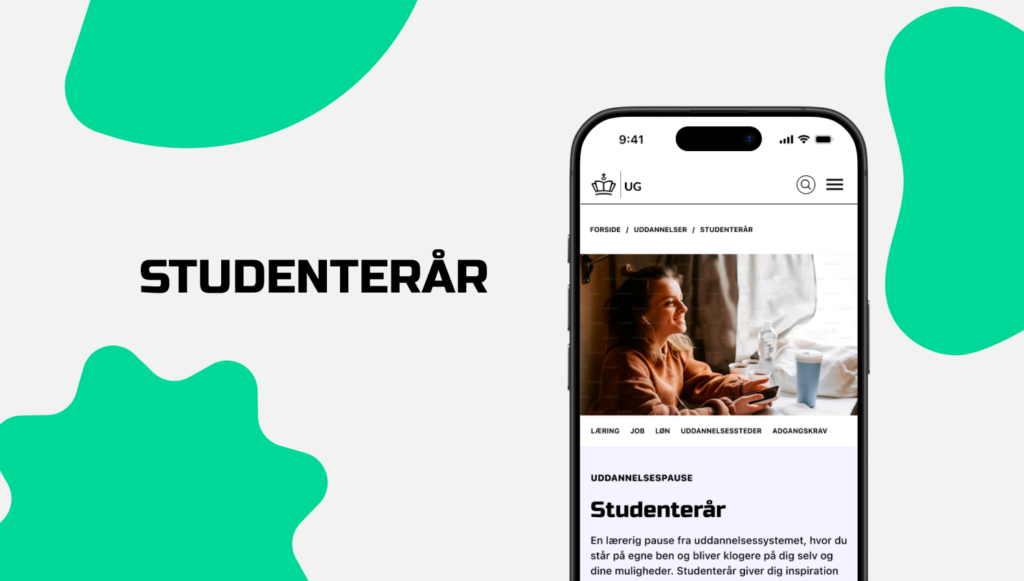
Studenterår is a conceptual feature for UG.dk (UddannelsesGuiden) that reframes the traditional “gap year” as a legitimate, structured part of the educational journey.
Instead of positioning time off as a pause outside the system, the project introduces Studenterår as an “education” placed alongside formal programs on UG.dk — intentionally challenging how education is defined and presented.
The core idea is simple:
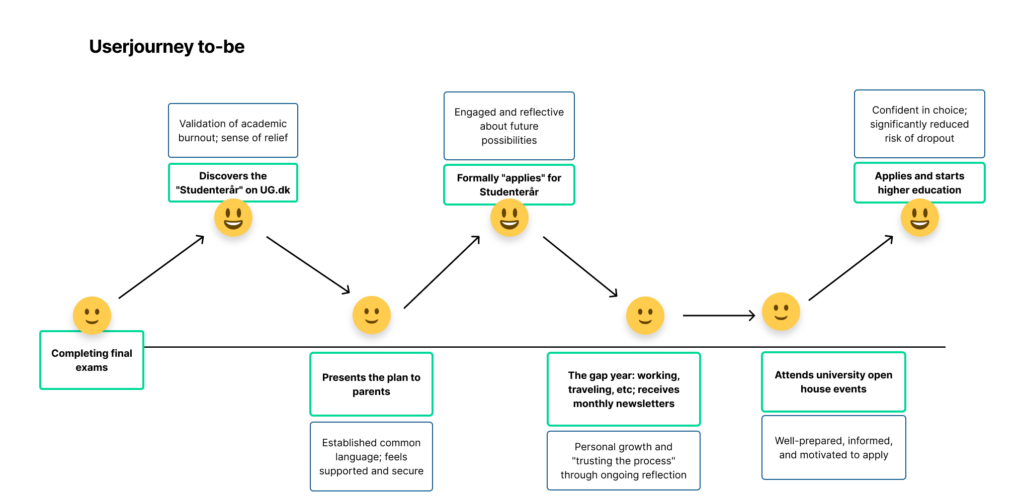
If young people increasingly take gap years, the system should acknowledge, support, and guide them during that time — rather than losing contact with them.
This project is a conceptual school project developed as part of a Digital Concept Development course. UddannelsesGuiden (UG.dk) is not affiliated with or involved in the project in any capacity.
Methods
The project followed the Double Diamond framework, combining quantitative research, service design thinking, and iterative prototyping. Insights were generated through desk research and a large-scale survey (144 respondents), supported by tools such as personas, empathy maps, customer jobs, and current/future user journeys. Concepts were developed through low- and high-fidelity wireframes and validated using guerrilla usability testing, with iterations based on feedback and time constraints.

The problem
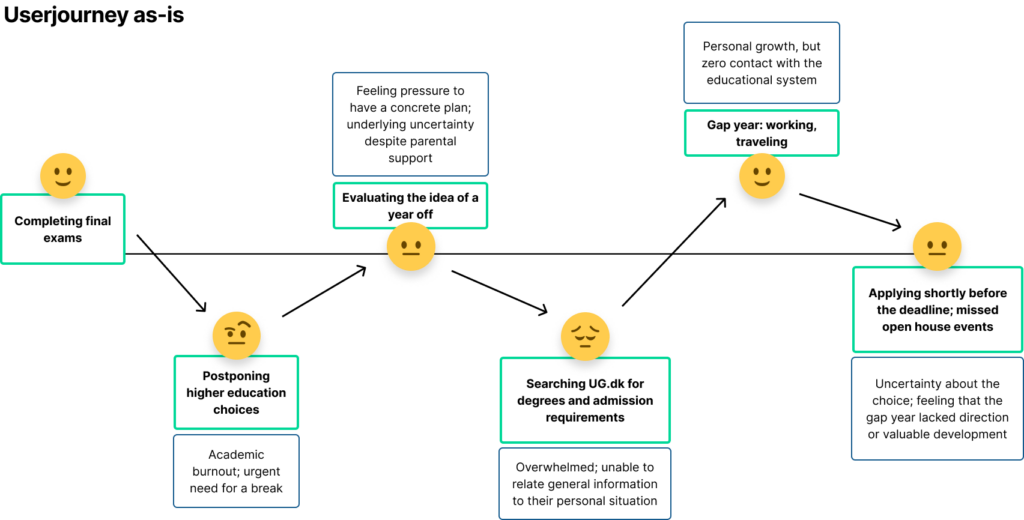
Young people finishing upper secondary education face three overlapping challenges:
- High uncertainty about future education
Many students enter sabbatical years without clarity about what they want to study — and lack ongoing guidance once they leave school. - Pressure to choose “correctly”
Structural changes (e.g. reduced SU flexibility) increase anxiety around making the wrong choice, which often leads to decision paralysis rather than faster decisions. - Parents as silent decision-makers
Parents have significant influence on educational choices, yet existing platforms primarily speak to students, not about reassurance.
At the same time, UG.dk functions mainly as a static catalogue of educations, offering limited support to users who are undecided or not ready to commit.
A “non-education” inside the system
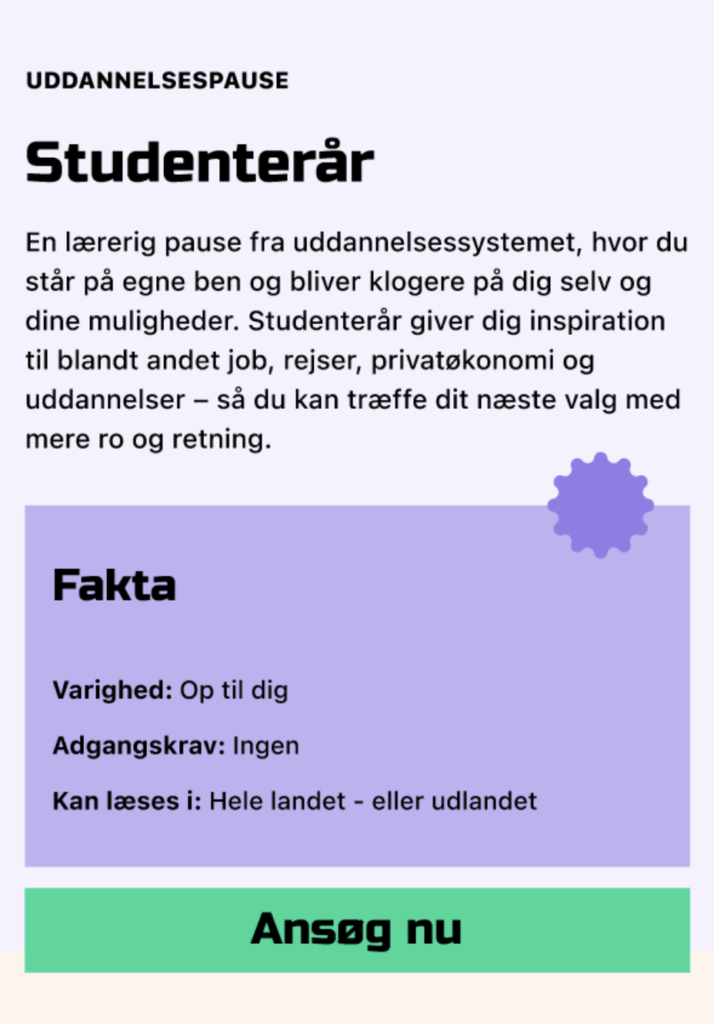
Studenterår is deliberately designed as a non-education presented in the same visual and structural language as formal programs on UG.dk.
By placing it next to existing educations, the concept:
- legitimizes time off as part of an educational path
- meets users where they already search for information
- “hacks” the mental model of what counts as education
The Studenterår page explains:
- the benefits of taking 1–2 years off
- how sabbatical years can increase completion rates in higher education
- why time for work, reflection, and exploration is not wasted time
A dedicated section explicitly addresses parents, reframing sabbatical years as a strategic, evidence-based choice rather than a risk.
Core feature: onboarding disguised as application
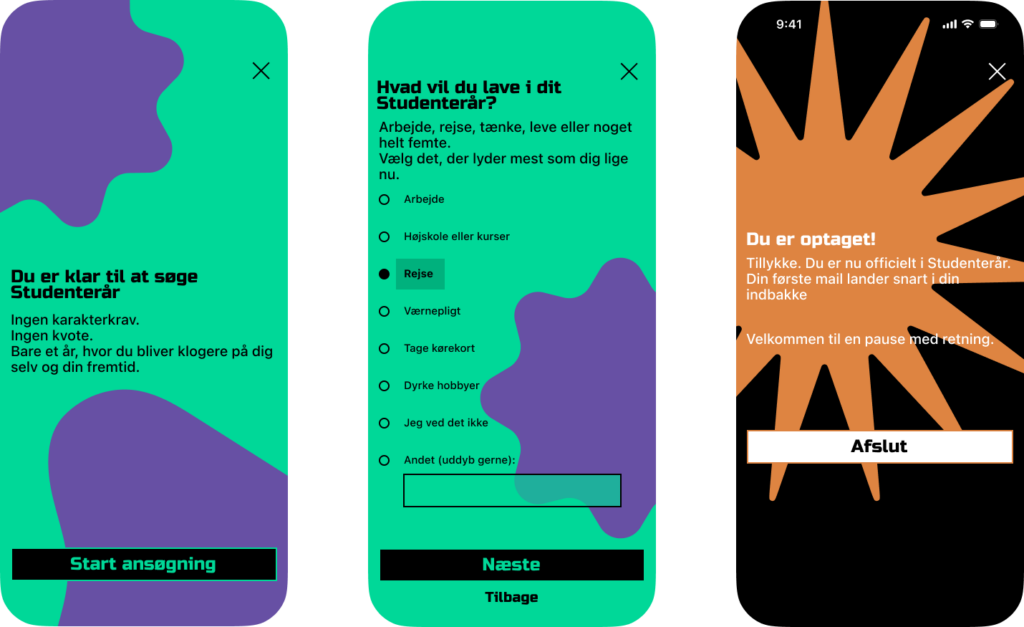
Central to the concept is a colorful, dynamic “application” flow embedded on UG.dk.
Although framed as an application to Studenterår, the flow does not enroll users in an actual program. Instead, it functions as:
- onboarding to a personalized newsletter
- a moment of guided self-reflection
- a data-light preference mapping tool
What it does in practice
During the flow, users:
- reflect on interests, doubts, and motivations
- indicate areas of curiosity (fields, formats, pace)
- signal where they are in their decision process
The value exchange
For young users
- Ongoing, low-pressure guidance during their sabbatical year
- Periodic reminders to explore educations — without forcing a decision
- Content tailored to interests rather than deadlines
For UG.dk
- Insight into undecided users who normally disappear from the platform
- Better segmentation for guidance-oriented communication
- A shift from one-time information delivery to long-term relationship building
The “application” framing lowers the barrier to participation by using a familiar interaction pattern — while subtly transforming indecision into engagement.
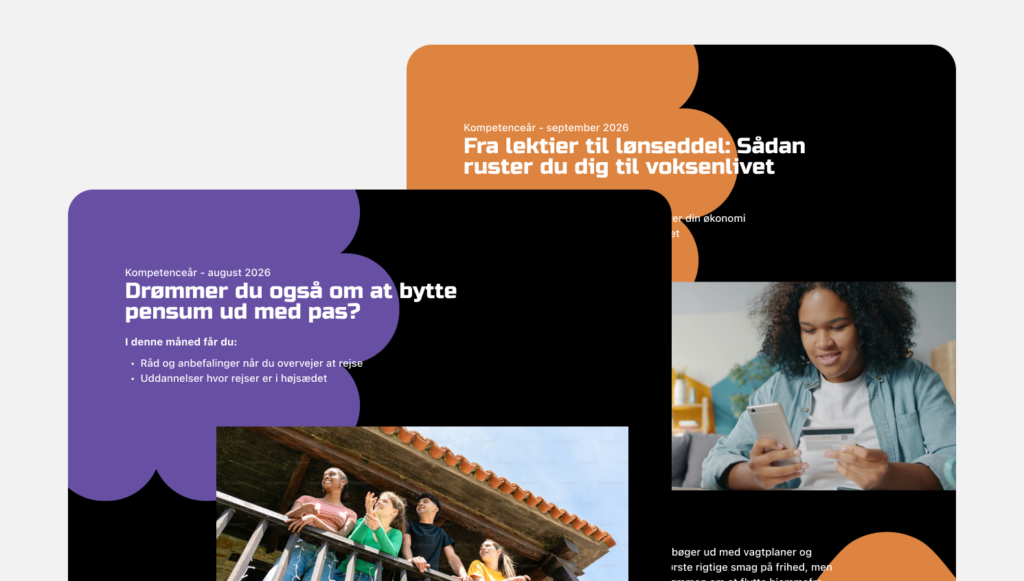
Role of the newsletter
The newsletter is the actual product, but intentionally kept in the background.
Rather than being promoted as “sign up for a newsletter,” it is presented as:
- a natural continuation of Studenterår
- a support mechanism during a legitimate phase of life
- a service that adapts as the user’s clarity evolves
Importantly, parents are addressed on the UG.dk page, not as recipients of the newsletter, reinforcing trust without interfering in the young person’s autonomy.